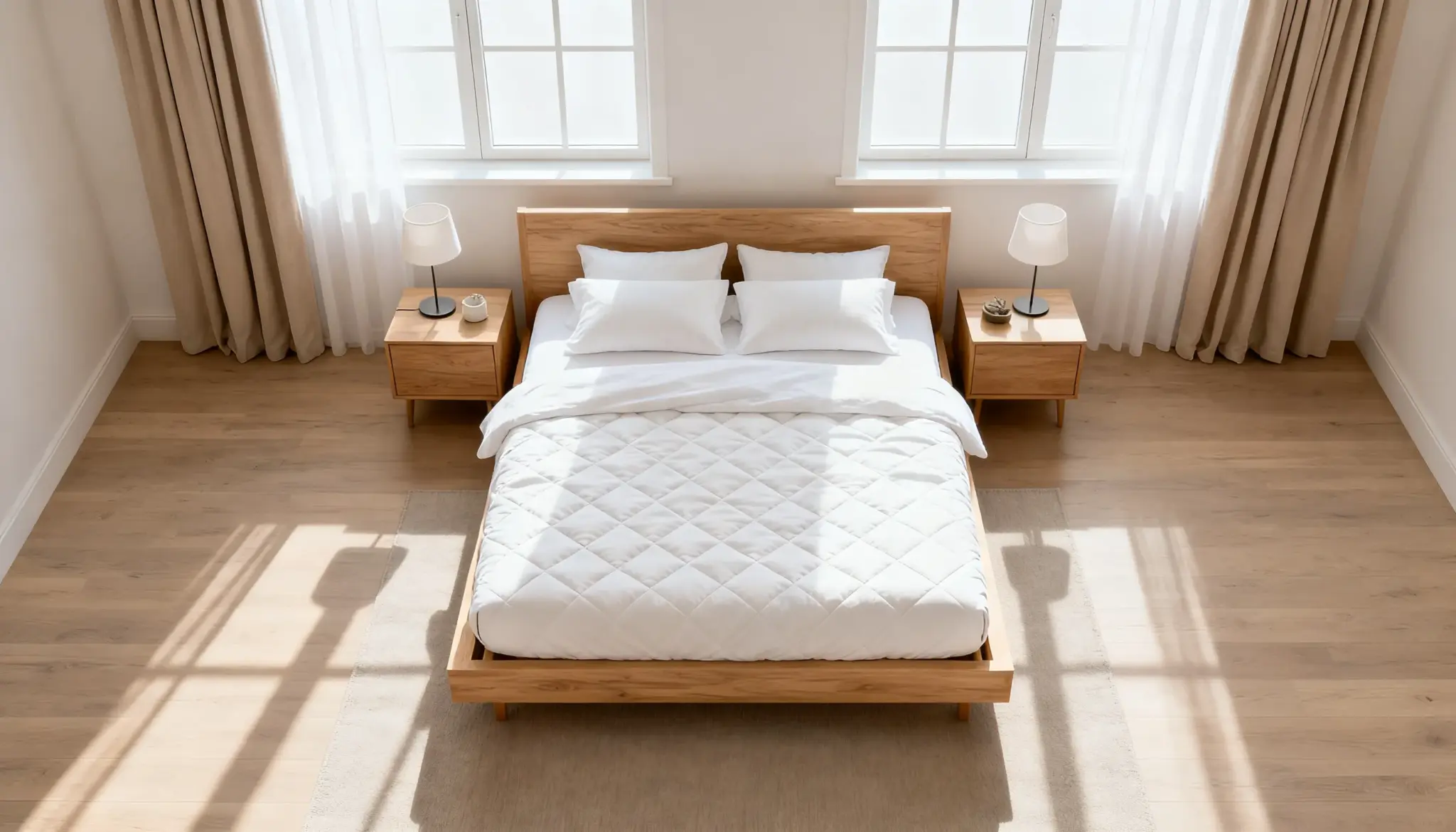
A king bed measures 76 by 80 inches – full stop.
But that number won’t tell you if it fits your room, your relationship, or the hallway you’ll have to drag it through on moving day.
Couples who keep elbowing each other awake at 2 a.m., parents with a toddler, anyone whose dog has claimed a corner of the mattress as its own- a king solves for most of that.
Keep reading to find the full breakdown: standard king dimensions, the oversized sizes most guides skip entirely, how a king stacks up against a queen and a California King, and what changes once a frame and headboard enter the picture.
Standard King Size Bed Dimensions

A standard king-size bed, also known as an Eastern king bed, measures 76″ wide by 80″ long. A king-size bed is the largest standard bed size, measuring one full size larger than a queen-size bed.
King-size bed dimensions are:
- Width: 76 inches (about 193 cm)
- Length: 80 inches (about 203 cm)
- Total surface area: 6,080 square inches
Width: 76 Inches (About 193 cm)
This is the number that actually separates a king from every other mattress size.
Seventy-six inches gives two adults close to a full twin bed’s worth of space each, which explains why kings work so well for restless sleepers or couples who don’t want to feel every toss and turn.
If a queen ever felt tight at night, this extra 16 inches is usually the fix.
Length: 80 Inches (About 203 cm)
Here’s the part that trips people up: a king isn’t longer than a queen, it’s the exact same 80 inches. So if height was the reason for upgrading, a standard king won’t solve that.
Anyone over 6 feet tall who wants more legroom should look at a California King instead, since that’s where the extra length actually shows up.
Total Surface Area: 6,080 Square Inches
Multiply the width by the length, and this is what a king actually gives two sleepers to work with.
Put another way, that’s close to 42 square feet of mattress, more than what most twin-size beds cover combined.
It’s a useful number to keep in mind when comparing sheet sizes too, since fitted sheets are cut to match this exact footprint
To put this into perspective: a standard king mattress is exactly the size of two Twin XL beds pushed together side by side.
That gives each sleeper 38 inches of personal space, plenty of room for restless sleepers or anyone who moves around a lot during the night.
King Size Bed Dimensions in Feet
Inches work fine on a spec sheet, but feet are what actually help when you’re staring at an empty room trying to guess if a king will fit.
A standard king comes out to 6’4” wide and 6’8” long.
That’s roughly the height of a tall adult lying end to end, with a bit of room to spare. For width, think of two people lying shoulder to shoulder with almost 3 feet each, more like two twin beds than one shared mattress.
When shopping for a bed frame, add extra space beyond the mattress itself. Most frames run a few inches wider and longer on each side, so a room that’s exactly 6’4″ wide won’t work.
Leave at least 2 to 3 feet of walking space around the bed on every side you plan to use, especially near nightstands or a closet door.
Also read – The Correct Rug Size for King Size Bed
King Bed Frame and Headboard Dimensions
Now you know that a king mattress measures 76 by 80 inches, but the finished bed usually takes up more space.
The frame, headboard, footboard, and side rails all affect the final footprint, so mattress measurements alone are not enough when planning the room.
King Bed Frame Footprint
Most standard king bed frames measure 78 to 81 inches wide and 82 to 85 inches long on the outside, which works out to roughly 1 to 5 inches added beyond the mattress on each side.
Bulky upholstered, wingback, or storage designs can add more than that.
Check the full product dimensions, not just the mattress size, and measure nearby doors, walkways, nightstands, and wall space before ordering.
King Headboard Width
A standard king headboard is commonly around 79 to 81 inches wide, making it slightly broader than the 76-inch mattress.
Oversized or wingback designs may be much wider, so confirm where the outer edges will sit, especially when placing nightstands or wall-mounted lights beside the bed.
King Headboard Height
King headboards are often between 48 and 65 inches tall when measured from the floor. Lower designs suit rooms with low ceilings, while taller upholstered headboards create a stronger visual feature.
Always check whether the listed height includes the legs and frame attachment or only the padded section.
Once you’ve chosen the right bed size, don’t overlook the rug. The right rug placement helps the room feel balanced and proportional.
Mattress Dimensions Chart for Queen, King and California King Beds
This is the comparison most people search for right after learning king-size bed dimensions. A king and a queen share the same length (80”), so the extra size in a king comes entirely from width.
It’s easy to assume these three sizes are more similar than they are.
Overview
| Size | Dimensions | Best For |
|---|---|---|
| Super King | 72″ x 78″ | Couples who want more width than a queen but can’t fit a full standard king — smaller than a King, not to be confused with a California King |
| Texas King | 80″ x 98″ | Tall sleepers and families who want significantly more length than a standard king |
| Wyoming King | 84″ x 84″ | A square layout for couples plus kids or pets who need extra width and length equally |
| Vermont King | 96″ x 96″ | Large families or anyone furnishing a primary suite built around one oversized centerpiece bed |
| Alaskan King | 108″ x 108″ | The largest common novelty size — built for co-sleeping families of four or more |
Queen Size Bed Dimensions

60” wide x 80” long. Fits smaller rooms and guest rooms where a king would feel oversized. On a queen, each person sleeping side by side gets about the width of a Twin XL mattress.
A queen-size bed wins on flexibility and fits more rooms comfortably.
Related – Queen Size Blanket Dimensions: Exact Measurements and How to Pick the Right Fit
California King Size Bed Dimensions

72” wide x 84” long. Four inches narrower than a standard king and four inches longer.
Better for anyone over 6 feet tall. California King wins for taller sleepers who need the extra length more than the extra width.
Beyond the Standard King: Oversized and Specialty Sizes
A handful of oversized “novelty king” sizes exist for anyone who’s outgrown even a standard king (families who pile in together, tall sleepers, or couples who just want more room than a normal bedroom set can offer).
These aren’t found in stores, so bedding and frames usually need to be special/custom ordered.
Also, before ordering any of these, confirm two things:
1. That the room can actually fit the frame with walking space on at least two sides.
2. And that a mattress protector, sheets, or a custom bedding source is available in that exact size.
Is a King Bed the Same Size Everywhere?
Nope, everything above is the US standard. “King” means something different depending on where the bed is made.
A UK king measures 60″ x 78″, nearly 16 inches narrower than a US king. Australia’s king comes in at 72″ x 80″, and New Zealand’s is 65″ x 80″.
If you’re shopping from outside the US, or buying bedding for a bed that was made elsewhere, don’t assume “king” means 76″ x 80″.
Check the country of manufacture first.
Now, Let’s Look at the Best King-Size Mattresses (Best Choice)
King-size mattresses come in hybrid, memory foam, latex, and innerspring options. The best choice depends on firmness, sleep position, motion control, cooling needs, and budget.
Best Hybrid Options
Hybrid mattresses ($800+) combine coils with foam or latex, making them a popular choice for king-size beds where edge support and motion isolation matter most.
Forbes Vetted names the Helix Midnight Luxe ($1,489–$2,299) its top king-size pick for excellent edge support and balanced comfort across different sleeping positions.
It also recommends the Bear Elite Hybrid ($1,856–$2,051) for couples, thanks to its strong motion isolation and pressure relief.
Other All-Foam Option
If you’re open to alternatives beyond Nectar, the Tempur-Pedic TEMPUR-Adapt is another highly rated all-foam mattress.
Its proprietary TEMPUR® material delivers excellent pressure relief and minimizes partner movement, making it a premium choice for king-size beds.
Who are King-Size Mattresses Ideal for?
A king isn’t the automatic best choice just because it’s the biggest option. It tends to work well for specific situations:
- Couples who move a lot at night and keep waking each other up
- Parents who end up with a kid or two crawling into bed most mornings
- Anyone sharing the bed with a large dog that claims a corner
- Taller or larger framed sleepers who feel cramped on a queen
- Primary bedrooms with enough square footage to spare, usually 12 by 12 feet or more
It’s not a great fit for smaller bedrooms, studio apartments, or solo sleepers who don’t need the extra width. In those cases, a queen usually makes more sense and leaves more floor space for furniture.
Renters moving often should also weigh the size, since king mattresses and frames are harder to maneuver through tight hallways and stairwells. That’s true for homeowners too — a king frame that won’t turn a stairwell corner is a common, and expensive, surprise on moving day.
Conclusion
A standard king bed measures 76 by 80 inches, but the frame, headboard, walking space, and mattress type also affect the final fit.
It works best for couples, families, restless sleepers, and larger bedrooms.
A queen suits tighter rooms, while a California king offers extra length for taller sleepers.
Before buying, measure the complete bed footprint, check doorway clearance, and choose a mattress that matches your sleeping position, firmness preference, and available budget.
Frequently Asked Questions (FAQs)
1. How to Convert King Bed Dimensions from Inches to Centimeters?
Multiply each measurement by 2.54. A 76″ x 80″. King comes out to roughly 193 cm x 203 cm.
2. Can two Twin XL mattresses replace a king mattress
Yes, that combination is called a Split King and matches a standard king’s 76″ x 80″ footprint exactly.
3. Will a King Bed Fit in a 10′ X 10′ Room?
Technically yes, but 12′ x 12′ is the recommended minimum for comfortable walking space and furniture.