You measured the sofa online as 84 inches wide. Your wall is 90 inches.
Plenty of room, right? The sofa arrives, and you can’t even open the closet door next to it.
People only measure one wall and call it done. Then they’re stuck with a return fee and a furniture-sized regret.
Getting accurate measurements takes less than 10 minutes. It saves you from a costly mistake that’s very hard to undo. In this blog, I’ll show you exactly how to measure room for furniture the right way.
From wall lengths to doorway widths, you’ll know every number before you ever place an order.
Why Does Accurate Measurement Matter Before Buying Furniture?
Accurate measurement does more than confirm that a furniture layout and piece fit.
It helps you plan how people will move through the room comfortably.
There’s a standard rule most interior planners follow: leave at least 30 to 36 inches of walking space between furniture pieces.
Without that, even a correctly-sized sofa can make a room feel tight and uncomfortable.
Measurements also help you spot problems early. A wardrobe might fit against the wall, but block a heating vent.
A dining table might fit the space, but leave no room to pull the chairs out.
Getting the numbers right before you buy means fewer surprises and no expensive return trips.
Room Size Calculator for Planning a Room for Furniture
Mapping Your Rooms Core Dimensions and Area
Mapping helps to understand both room dimensions and how to measure furniture correctly, since both need to match for a layout to actually work in real life.
Here’s what to measure:
- Length and width: Measure all four walls, not just two. Walls are not always perfectly equal.
- Ceiling height: This matters for tall units, such as bookshelves or wardrobes.
- Alcoves and recesses: Note any areas that cut into the wall space.
- Fixed features: Mark down radiators, plug sockets, and light switches.
Write down every number. A simple hand-drawn room sketch suffices, nothing fancy, just accurate.
Measuring Tools and Must-Haves
Before you start, gather these tools. Having everything ready saves you from having to stop mid-measurement.
| Tool | What It’s Used For |
|---|---|
| Measuring tape (25 ft) | Measuring wall lengths, widths, and heights |
| Graph paper | Drawing a scaled floor plan of your room |
| Pencil | Marking measurements as you go |
| Notepad | Recording all numbers in one place |
| Smartphone camera | Photographing the room for reference |
| Laser distance measurer | Getting quick, precise readings in larger rooms |
| Masking tape | Marking furniture dimensions on the floor |
Things to Remember When Measuring Rooms
A few small details can make a big difference when measuring.
Always measure in inches rather than feet. Inches give you more precise numbers and reduce rounding errors.
Take every measurement at least twice. A single reading can be off without you realizing it.
Account for skirting boards and wall trims. They sit slightly in front of the wall, reducing your usable width by a small but important amount. Finally, update your measurements after any renovation work.
Even a fresh coat of plaster can slightly change wall dimensions.
How to Measure Room for Furniture Properly
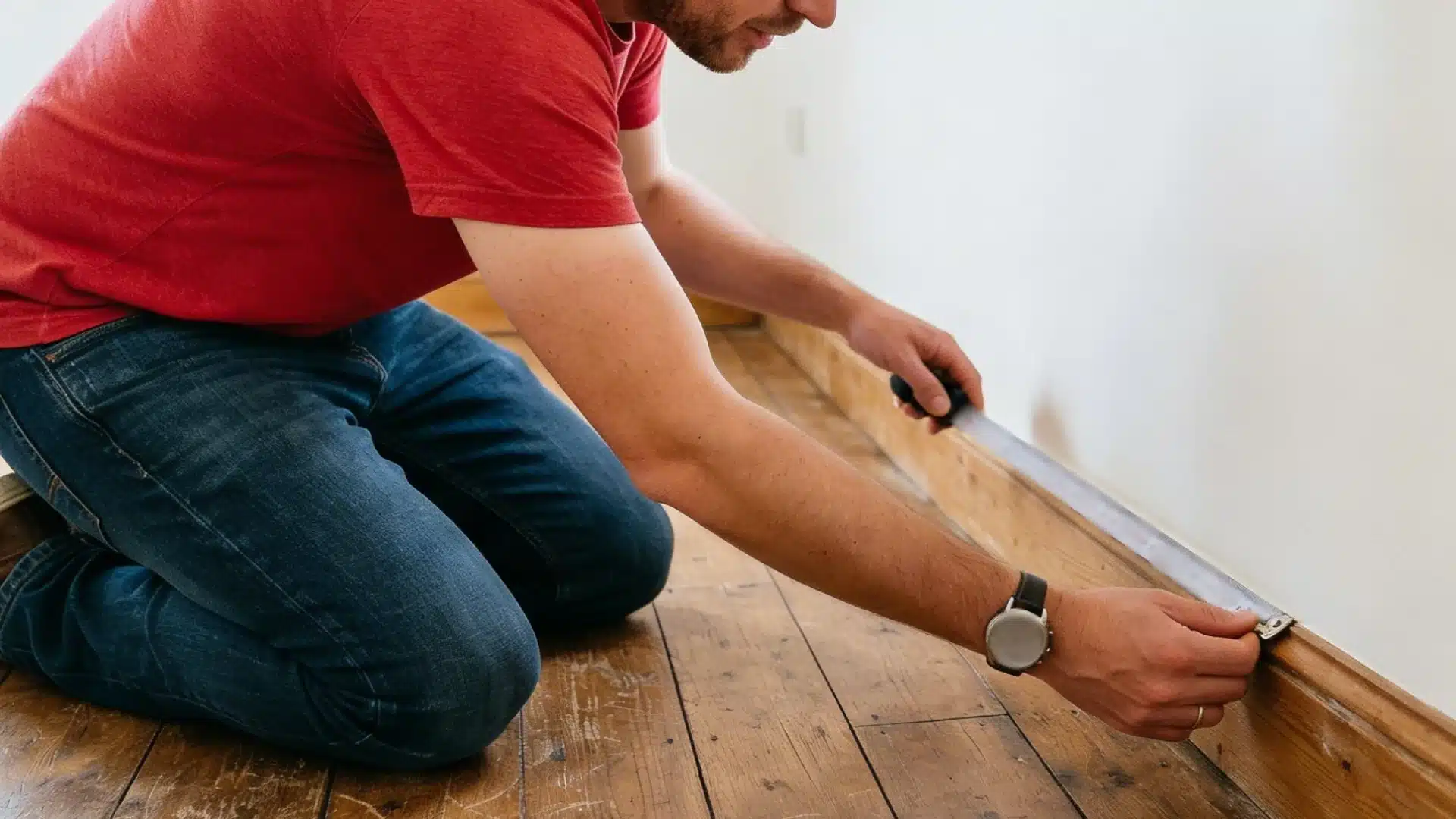
Here’s the exact process to follow. Take it one step at a time.
Step 1: Clear the Room’s Perimeter
Move any objects sitting against the walls.
Boxes, decorations, or existing furniture can throw off your tape measure. You need a clean, unobstructed path along every wall before you take a single measurement.
Even a small object in the corner can shift your tape by several inches.
Step 2: Measure Every Wall Individually
Run your tape along each wall, from corner to corner. Write each number down immediately. Don’t rely on memory. Walls vary in shape, so each reading may differ.
Those small differences matter more than most people expect.
Step 3: Measure Doorways and Windows
Note the width and height of every doorway and window. Include how far each window sits from the floor.
This tells you which walls can hold tall furniture and which ones cannot.
A window sitting low on a wall rules out a tall sideboard or bookshelf right there.
Step 4: Mark Architectural Features
Measure the exact position of plug sockets, light switches, vents, and radiators. Note how far each one sits from the nearest corner.
These features directly affect where furniture can and cannot go.
Placing a sofa over a vent, for example, is a problem you want to catch early.
Step 5: Measure Floor-to-Ceiling Height
Stand in the center of the room and measure straight up. Do this in at least two spots.
Older homes sometimes have uneven ceilings, which significantly affects the placement of tall furniture.
A wardrobe that fits in one corner may not sit flush in another.
Step 6: Tape Out Furniture Dimensions on the Floor
Use your masking tape to mark the exact footprint of each furniture piece on the floor.
Walk around it. Open any nearby doors. This shows you immediately whether the layout works in real life. It’s the simplest way to avoid a costly mistake before anything gets delivered.
How to Measure the Area of a Room
Measuring the area of a room is clear once you have your wall measurements ready.
Multiply the length of the room by its width. That gives you the total floor area in square feet or inches, depending on your preferred unit. For a standard rectangular room, that’s all it takes.
Most rooms aren’t perfect rectangles.
Here’s how to handle that:
- Break the room into smaller rectangular sections and measure each one separately.
- Multiply the length and width of each section individually.
- Add all the totals together for the full floor area.
Always use the same unit throughout.
Mixing inches and feet in the same calculation is one of the most common measuring mistakes.
How to Measure for Furniture Delivery
Getting furniture into your room is a separate challenge from fitting it once it’s there. Measure these spots before your delivery day.
Step 1: Measure the width and height of your front door opening.
Step 2: Check any secondary entry points, such as side or patio doors.
Step 3: Measure the width of your hallway from wall to wall.
Step 4: Note any sharp turns or corners that the furniture needs to pass through.
Step 5: Measure the staircase width if the furniture is going to an upper floor.
Step 6: Check the height of any low ceiling areas along the delivery path.
Step 7: Measure elevator dimensions if you live in an apartment building.
Step 8: Compare all these numbers against the furniture’s packaged dimensions, not just its assembled size.
Measurement Tips for Different Furniture Pieces
Every room has its own set of challenges.
A bedroom works differently from a living room, and a dining space has its own rules entirely.
A table might fit the space perfectly, but seated guests need at least 24 inches of clearance behind them.
Measuring for a dining table
Start with the room’s usable floor space, not the total area.
A standard dining table needs at least 36 inches of clear space on all sides for comfortable movement. Account for how far chairs slide back during use, that space disappears quickly.
Measuring for a bed
Measure from wall to wall, then subtract space for any bedside units you plan to add. That gives you the true width available for the bed frame itself.
- Leave at least 24 inches on the sides you walk around daily.
- Check that the bed frame clears any low windowsills or built-in storage at the foot of the bed.
Measuring for a sofa
Note the distance between the sofa and the opposite wall or TV unit. A comfortable viewing and conversation distance sits between 7 and 10 feet.
Also measure the sofa’s diagonal depth this affects how much floor space it actually takes up.
Measuring awkward angles & shapes
Bay windows, chimney breasts, and angled walls need individual attention.
Measure the widest and narrowest points separately. Never assume symmetry; one side of a chimney breast is rarely identical to the other.
Measuring dressers and nightstands
Drawer clearance is something most people completely overlook.
Most dressers need at least 30 inches of open space in front to function properly.
- For nightstands, check the height against your mattress top, ideally within 2 to 4 inches.
- Confirm the width leaves enough gap to allow a full bedroom door swing without obstruction.
Room Measurements vs Usable Space
Your room’s total size and the space you can actually use are two very different numbers. Always plan around your usable space, not your total room size.
Here’s how they compare:
| Space Type | What It Means | Example |
|---|---|---|
| Total floor area | Full room dimensions, wall to wall | 12 ft x 14 ft room |
| Usable floor space | Area left after fixed features | Space minus radiator, door swing |
| Traffic pathways | Walking space between furniture | 30-36 inches minimum |
| Furniture footprint | Floor area a piece physically occupies | Sofa base, not armrest height |
| Dead space | Areas furniture cannot occupy | Behind the door, under the window |
| Visual space | How open the room feels to the eye | Affected by furniture height and color |
Easy Tricks to Visualize Furniture Before Buying
Before spending a single dollar, try these simple tricks to see how furniture will actually look and fit in your space.
Use cardboard cutouts
Cut the cardboard to match the exact dimensions of the furniture piece.
Lay it flat on the floor to get a true sense of its size.
Try a room planning app
Free apps like RoomSketcher or MagicPlan let you enter your measurements and place scaled furniture in your room virtually.
Use bedsheets or newspapers
Spread them on the floor to the exact furniture size for a quick, free check of proportions.
Photograph the space
Take photos from multiple angles.
Viewing the room through a lens often reveals spacing issues that are easy to miss with the naked eye.
Check furniture placement with a string
Run a piece of string across the floor to mark boundaries.
It’s a fast way to test different layout options without moving anything heavy.
Final Thoughts
Measuring a room for furniture doesn’t have to be complicated. Once you know how to measure room for furniture, the entire process becomes much easier and far more reliable.
Double-check your numbers. Account for doorways, walking space, fixed features, and delivery paths.
Use the floor-taping trick or a planning app before you commit to anything.
The difference between a room that feels right and one that feels cramped often comes down to a few careful measurements taken beforehand.
Got your tape measure ready? Start with one wall today; the rest follows naturally.
Frequently Asked Questions (FAQ’s)
1. What is the Ideal Space to Leave Between Furniture Pieces?
Always keep at least 30 to 36 inches of clear walking space between pieces.
2. Do I Need to Measure Ceiling Height for Furniture Placement?
Yes, especially for tall units like wardrobes or bookshelves against your walls.
3. How Can I Check if Furniture Will Fit Through Doorways?
Compare the furniture’s packaged dimensions against your doorway’s exact width and height
4. Should I Measure Furniture Depth as Well as Width?
Absolutely depth tells you how far a piece projects into your room.
5. What’s an Easy Way to Visualize Furniture Placement Before Buying?
Use a string, bedsheets, or a free room planning app before purchasing anything.