
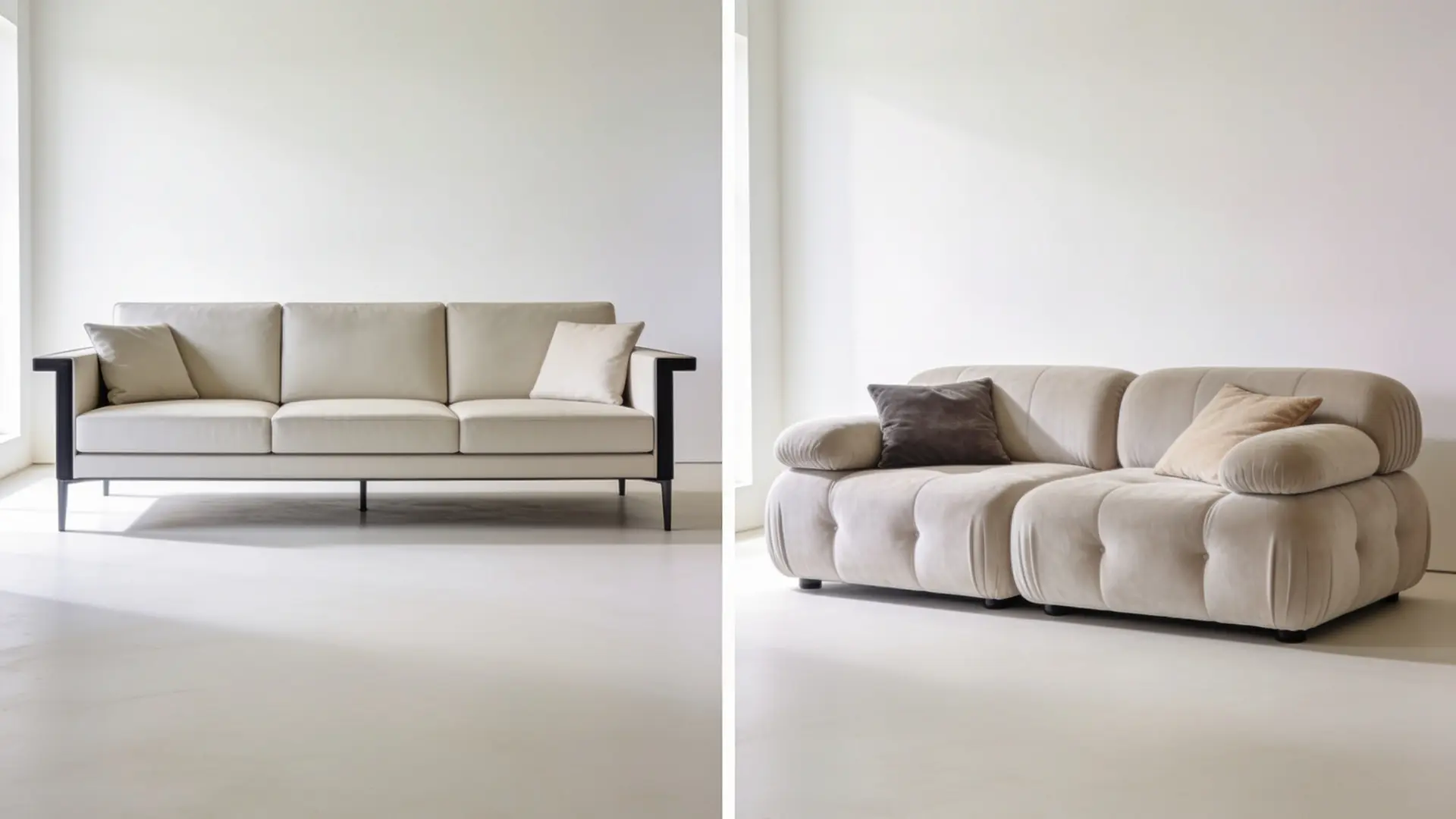
Couch vs sofa, who’s right? The answer sits somewhere in the middle.
Although the terms are often used interchangeably, they have different origins and carry slightly different associations.
Some people see a sofa as more formal and a couch as more casual, while others believe there’s no real difference at all.
Let’s see where the two words came from, how they’re commonly used today, and whether the distinction actually matters.
What is a Sofa?
The word “sofa” has the older history behind it.
Sofa comes from the Arabic word “suffah,” which referred to a long, raised bench covered with cushions. The word later passed through Turkish and French before becoming part of English.
A sofa is generally defined as a long upholstered seat with a back and armrests, designed for two or more people. Many examples feature a structured frame, supportive cushions, and a tailored appearance.
The term is commonly used in furniture stores, product catalogs, and interior design, since it sounds slightly more formal.
Types of Sofa
Sofas come in a few common styles, each suited to a different kind of space.
- Two-Seater Sofa: Compact and ideal for small living rooms or apartments.
- Three-Seater Sofa: The most common size, built for family rooms and open layouts.
- Sectional Sofa: Made of connected pieces forming an L- or U-shape.
- Chesterfield Sofa: Known for rolled arms and deep button tufting, often used in formal or traditional interiors.
- Sofa Bed: Folds out into a bed, useful for guest rooms or smaller homes.
What is a Couch?
This word comes from a very different background.
Couch comes from the French word ‘couche,’ meaning ’a bed’ or ’a lying-down place. Some even had only one armrest or none at all, since comfort was the main priority.
A couch generally refers to the main upholstered seating in a living room or family room.
While it describes the same type of furniture as a sofa, the word feels more relaxed and is the one many people naturally use in everyday conversation.
Types Of Couch
Couches also come in a range of styles, typically designed for comfort and everyday use.
- Loveseat: A smaller two-person option, great for cozy corners or apartments.
- Sleeper Couch: Converts into a bed, similar to a sofa bed but with a more casual style.
- Reclining Couch: Comes with one or more seats that tilt back for extra comfort.
- Modular Couch: Built from separate pieces that can be rearranged to fit different room layouts.
- Sectional Couch: A larger, connected piece designed for bigger families or media rooms.
Couch Vs Sofa: The Key Differences
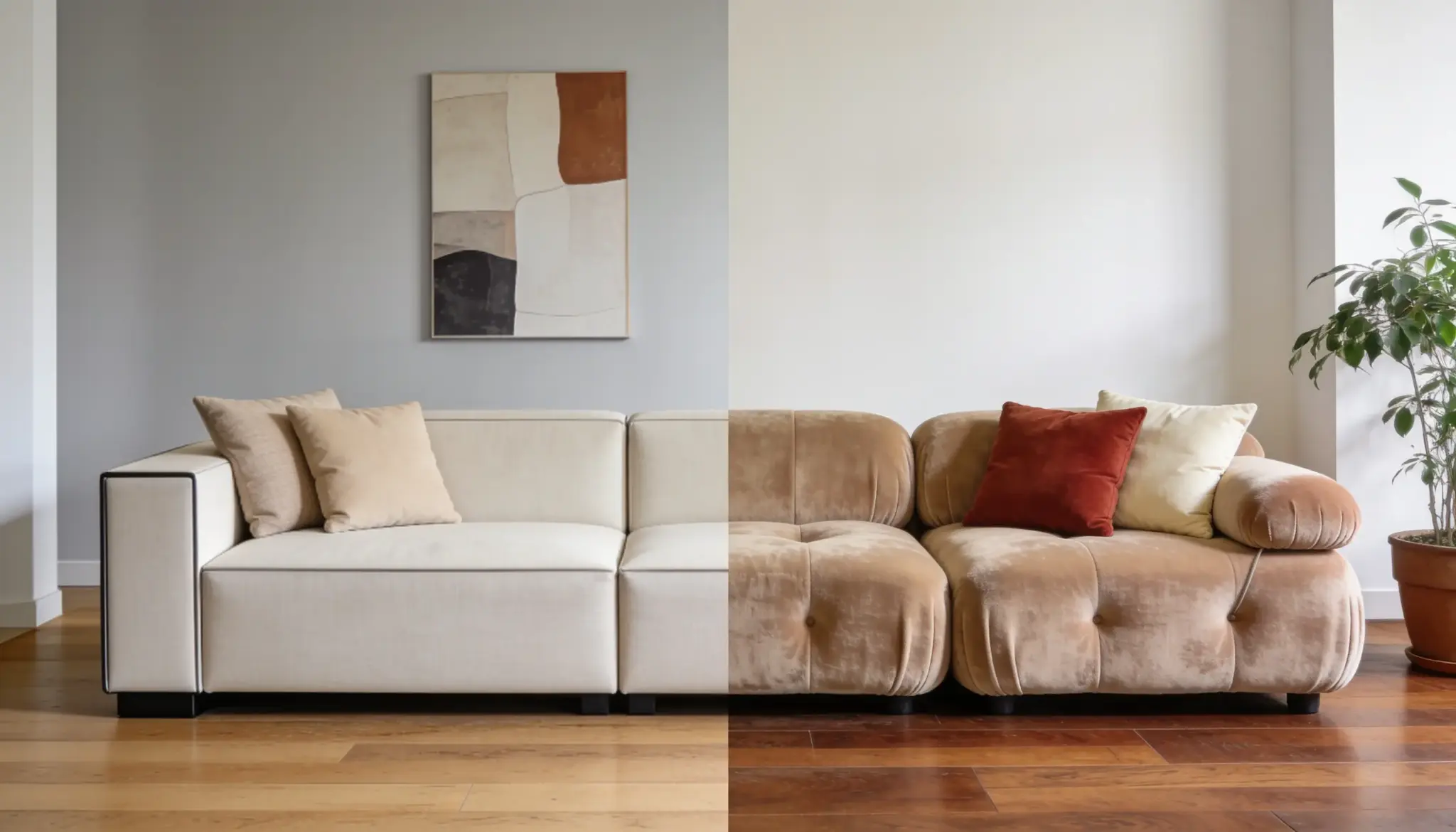
Although both terms usually refer to the same type of furniture, a few subtle differences show up in how people use each word.
1. Structure And Design
Although these distinctions aren’t universal, people often picture a sofa with defined arms, a supportive back, and clean, straight lines.
The frame usually feels more structured, and the cushions tend to hold their shape rather than sink in.
A couch tends to bring to mind softer cushions and a looser, more relaxed shape. Arms are lower, rounder, or missing altogether, and the silhouette feels less tailored than a sofa’s.
2. Common Usage
The biggest difference often comes down to context rather than furniture design.
Retailers, interior designers, and product catalogs tend to use “sofa,” since it reads as more polished in a listing or a showroom.
Homeowners, on the other hand, are more likely to say “couch” once that same piece sits in their living room.
It’s common for someone to buy a “sofa” from a store and call it a “couch” the moment it’s home. This shift shows how much the word choice depends on the setting rather than the actual object.
3. Formality
Neither word changes what the furniture is, but each one creates a different impression the moment it’s said out loud.
“Sofa” tends to sound more polished or professional, which is why it shows up so often in real estate listings, design magazines, and upscale showrooms.
“Couch” feels casual and familiar instead. It’s the word people reach for when describing a lazy Sunday, a family movie night, or a spot for the dog to curl up on.
Neither impression is right or wrong; they convey different tones of the same object.
4. Comfort And Feel
One way to think about it: support versus relaxation.
A sofa’s firmer cushions and higher seat height tend to encourage good posture, making it a comfortable option for longer conversations or formal seating.
A couch usually goes the other direction, with deeper seats and plusher cushions built for sinking in.
That extra depth and softness invite stretching out, napping, or curling up with a blanket, rather than sitting upright for hours.
5. Materials
Contrary to popular belief, no material is exclusive to either one.
Both versions come in multiple fabrics, and both can be built with the same frame materials, including hardwood, engineered wood, or metal.
The upholstery depends on the manufacturer and intended use, not on which name gets used at checkout.
A leather sofa and a leather couch can be nearly identical pieces of furniture with two different labels attached.
Is There Actually A Difference Between a Couch And a Sofa?
Ask ten people whether there’s a real gap between the two, and you’ll probably hear different opinions.
Some associate sofas with formal living rooms and couches with casual spaces. Others use the two words without ever thinking twice.
Online discussions often reflect this same split. Some people argue that a sofa belongs in a formal living room, while a couch is where you relax with family.
Others dismiss the distinction entirely and use whichever word comes naturally.
Modern dictionaries define both as upholstered seating for two or more people, which suggests the distinction is more about convention than function.
When Does The Difference Actually Matter
For everyday conversation, it usually doesn’t. There are, however, a few situations where the wording carries a bit of weight.
- Furniture stores often lean toward “sofa” because it sounds more polished on a label.
- Interior designers may prefer the same word when discussing room layouts.
- Real estate listings sometimes use it to give a space a more refined feel.
- Product catalogs frequently use “sofa” even when the everyday name is “couch.”
In practice, searching for either term online usually leads to the same furniture categories and product listings.
Which One Should You Use?
When shopping for furniture, the name matters much less than the furniture itself. Focus on:
- Room size and layout
- Upholstery material
- Frame quality and construction
- Seat depth and cushion firmness
- Warranty and budget
These factors will shape the purchase far more than the word printed on the price tag.
Conclusion
While “couch” and “sofa” come from different histories, today’s furniture industry treats them almost the same.
Understanding the subtle differences can help when shopping or reading product descriptions.
But the decision should ultimately come down to the furniture’s comfort, size, and construction rather than its name.
For most people, either term works confidently, since the distinction is more about language and preference than function.
Frequently Asked Questions (FAQs)
1. Which One Costs More, a Couch or a Sofa?
Neither term affects the price. Cost depends on factors such as materials, construction quality, size, brand, and features.
2. What is Slang for Sofa?
“Couch,” “settee,” “davenport,” “chesterfield,” or “lounge”, depending on region and formality of speech.
3. Is it Wrong to Use “Couch” And “Sofa” Interchangeably?
No. Most homeowners, retailers, and even many designers use the terms interchangeably, and there’s no strict rule that separates one from the other.