
Most people misplace rugs by sliding them under the bed, only to wonder why the room feels off.
There are specific rules about how much should peek out from under your bed.
Get it right, and your bedroom looks polished. Get it wrong, and it throws off the entire space.
These simple approaches will help anyone choose the right rug size and position it correctly.
This blog gathers rug under bed rules for different types of bed sizes and placements.
You will learn the right positioning, rug shapes, and materials, common mistakes, and how to choose the right alignment tips.
Rug Under Bed Rules You Should Follow
Following these rules creates a bedroom that feels finished and well-designed.
Leave 18 to 24 inches of rug exposed on each side of the bed
This measurement gives enough soft surface for the feet when getting up. Less than this makes the rug look skimpy and defeats its purpose entirely.
Place two-thirds of the rug under the bed, one-third exposed
This ratio creates proper proportions. Too much rug hidden underneath wastes material,
While too little makes the bed appear to float awkwardly above the floor surface.
Ensure nightstands sit partially on the rug when possible
Either the front legs or the entire nightstand should rest on the rug.
This anchors furniture together as a cohesive unit rather than separate, disconnected pieces scattered around.
Match rug size to room dimensions, not just bed size
A large rug in a small room makes it feel crowded. Consider walkway space and how much bare floor should show around the rug’s edges to balance it.
Tips for Getting the Rug Placement Right
- Use painter’s tape on the floor to mark rug boundaries first.
- Check clearance for doors that swing into the bedroom.
- Account for baseboard heaters or floor vents in placement.
- Consider how much space you’ll need around the edges.
- Allow extra inches if the bed has a low platform frame.
- Remember that rug pads prevent slipping and add cushioning.
- Rotate rugs every 6 months to prevent uneven wear.
- Steam wrinkles out immediately after unrolling new rugs.
Bedroom Rug Sizing by Bed Size and Type
This chart breaks down the exact rug sizes needed for different bed types and room dimensions.
| Bed Type | Bed Dimensions | Area Rug Size | Bedroom Size | Nightstands | Rug Placement |
|---|---|---|---|---|---|
| Twin | 38″ x 75″ | 5′ x 8′ | 10′ x 10′ | One side only | 8” sides, 12” feet |
| Twin XL | 38″ x 80″ | 5′ x 8′ | 10′ x 12′ | One side only | 8” sides, 10” feet |
| Full | 54″ x 75″ | 6′ x 9′ | 10′ x 12′ | Both sides | 12” sides, 15” feet |
| Queen | 60″ x 80″ | 8′ x 10′ | 12′ x 12′ | Both sides | 18” sides, 18” feet |
| King | 76″ x 80″ | 9′ x 12′ | 13′ x 13′ | Both sides | 24” sides, 24” feet |
| California King | 72″ x 84″ | 9′ x 12′ | 13′ x 14′ | Both sides | 24” sides, 20” feet |
| Daybed | 38″ x 75″ | 5′ x 7′ | 9′ x 10′ | None or one | Against the wall placement |
| Bunk Bed | 38” x 75” each | 6′ x 9′ | 11′ x 11′ | None typically | Centered under both beds |
Note: Rug placement measurements show how many inches the rug should extend beyond the bed on sides and foot for proper proportions and comfort space.
What Size Rug Under a King Bed

King beds require large rugs to create a soft landing zone and frame the furniture without overpowering the space.
How Wide is King Size Bed?
A standard king bed measures 76 inches wide and 80 inches long, for rug coverage and proper balance.
| King Size Rug Type | Rug Dimensions | Placement Style | Coverage |
|---|---|---|---|
| Standard king rug | 8′ x 10′ | Under the lower two-thirds | Minimal side exposure |
| Spacious king rug | 9′ x 12′ | Under the lower two-thirds | 24” each side, 24” foot |
| Partial king runner | 3′ x 10′ | Foot of the bed only | Extends past the footboard |
| Side runners (pair) | 2.5’ x 8’ each | Both bed sides | Landing zones only |
| L-shaped placement | 8′ x 10′ | Angled corner position | One side and foot only |
Note: All measurements assume the bed is centered on the rug with equal exposure on the accessible sides, and placement percentages refer to how much of the bed’s footprint sits on the rug surface.
Rug Length
The length of king beds should be at least 10 feet to accommodate the 80-inch mattress plus overhang.
Shorter rugs leave the foot area exposed awkwardly.
Longer options, like 12-foot rugs, work better in spacious master bedrooms, giving ample room for movement without stepping onto cold floors right away.
Rug Width
The width needs to be 9 to 10 feet minimum for king beds to show proper side exposure.
The 76-inch bed width offers little margin for error. Narrower rugs fall under the frame, while 12-foot widths provide ample landing space and comfortably fit nightstands on the rug.
Why it Works
- The extended coverage balances the bed’s massive footprint.
- Creates symmetry on both sides for nightstands.
- Provides a comfortable barefoot space in the morning.
Rug Size for a Queen Bed
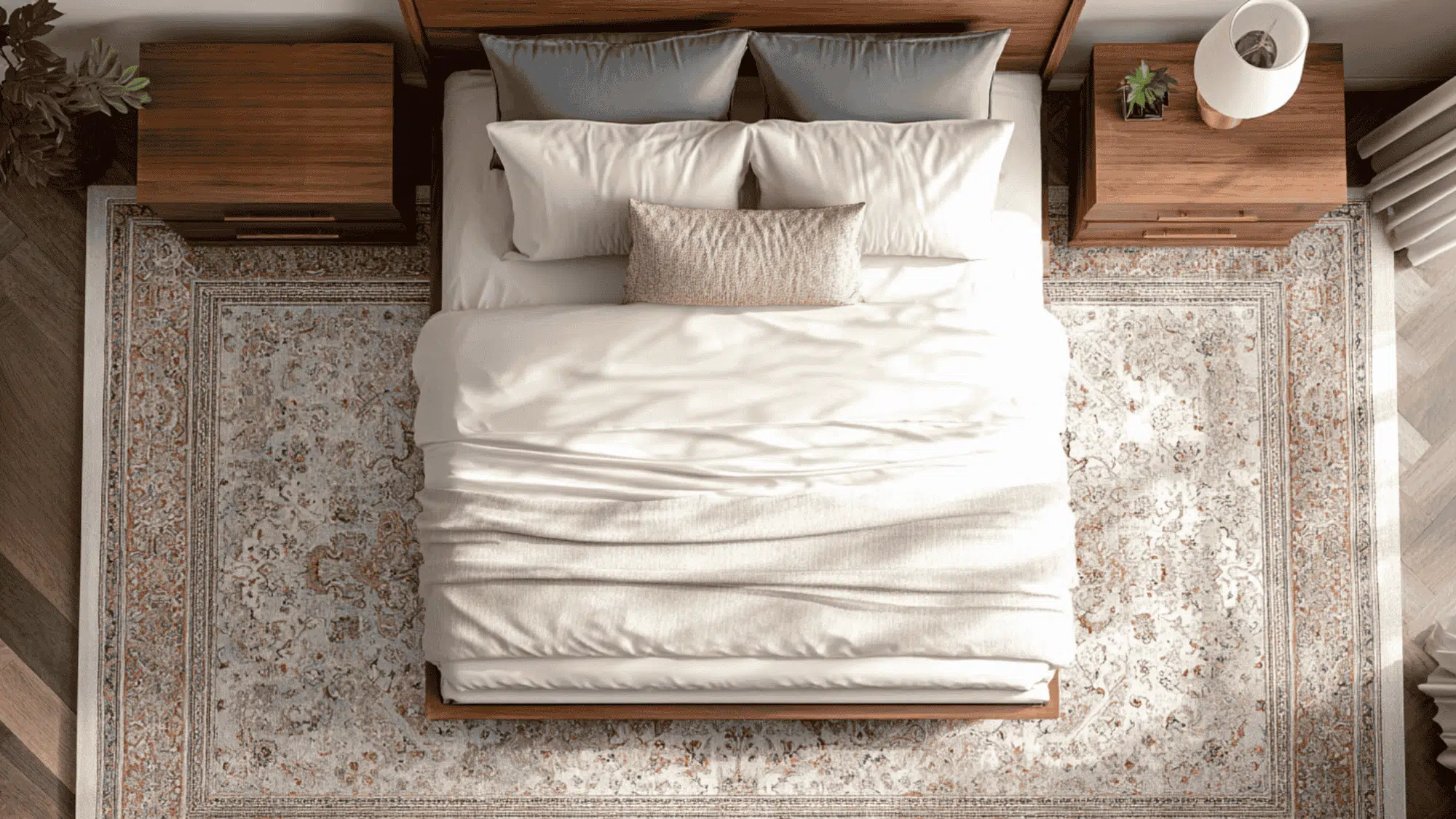
Queen beds work best with a small rug, with 18 to 24 inches on the sides and foot. This keeps the bed from dominating and offers enough soft surface for feet.
How Wide is a Queen-Size Bed?
A queen bed measures 60 inches wide and 80 inches long, fitting well in most queen rooms with suitable rug sizing.
| Queen Size Rug Type | Rug Dimensions | Placement Style | Coverage |
|---|---|---|---|
| Standard queen rug | 8′ x 10′ | Under the lower two-thirds | 18” sides, 18” feet |
| Compact queen rug | 6′ x 9′ | Under the lower half | 12” sides, 12” feet |
| Foot runner only | 3′ x 8′ | End of bed placement | Footboard extension only |
| Dual side runners | 2’ x 7’ each | Both sides separately | Landing pads only |
| Layered look | 5’ x 8’ over larger | Smaller centered on bigger | Decorative stacking effect |
Note: Queen beds work with various rug sizes depending on room dimensions, but these remain the most adaptable option for a balanced appearance and functional coverage.
Rug Length
Length determines how much rug shows at the foot of the bed. Longer rugs create a more lavish feel, while shorter ones can make the bed look like it’s placed awkwardly on a mat.
Measure from the headboard to where you want the rug to end, then add at least 18 inches.
Rug Width
Width controls side exposure and affects nightstand placement.
Calculate by adding your bed’s width to 36-48 inches on each side. Wider rugs allow nightstands to sit partially on the surface, anchoring the furniture as a cohesive group.
Why it Works
- Proportional to the bed’s 60×80 inch dimensions.
- Leaves enough exposed floor to define boundaries.
- Accommodates most standard bedroom sizes easily.
Things to Watch
- Smaller rugs make queen beds look cramped.
- Runner rugs rarely provide adequate coverage.
What Size Rug Under a Full Bed

The rug should peek out on the sides and at the foot for a cohesive look without occupying too much floor space.
How Wide is a Full-Size Bed?
A twin bed measures 54 inches wide and 75 inches long, requiring medium-sized rugs that don’t overpower smaller bedrooms.
| Full Size Rug Type | Rug Dimensions | Placement Style | Coverage |
|---|---|---|---|
| Standard full rug | 6′ x 9′ | Under the lower two-thirds | 12” sides, 15” feet |
| Minimal full rug | 5′ x 8′ | Under the lower half | 6” sides, 12” feet |
| Extended full rug | 8′ x 10′ | Under the entire bed | 24” sides, 24” feet |
| Single side runner | 2′ x 7′ | One side access | Exit side coverage |
| Corner position | 6′ x 9′ | Angled near the corner | Wall-adjacent placement |
| Floating centered | 6′ x 9′ | Middle of the room | Equal borders all around |
Note: Full beds fit in small to medium rooms, with 6’ x 9’ rugs balancing coverage and clutter.
Rug Length
A full bed length requires 8 to 9 feet of rug to achieve proper proportions. The 75-inch mattress needs sufficient extension at the foot to complete the visual.
Shorter lengths cut off too abruptly, making the setup feel incomplete.
Nine-foot rugs give breathing room and prevent the cramped appearance common with undersized options.
Rug Width
The width should measure 6 to 8 feet for full beds to maintain balance.
The 54-inch bed frame is centered with equal margins. Narrower widths lack enough stepping space. Wider options suit larger rooms to prevent crowding and tight arrangements.
Why it Works
- Matches the bed’s moderate scale perfectly.
- Provides enough coverage without excess fabric.
Things to Watch
- Too-small rugs look like bath mats here.
- Side exposure matters more than foot coverage.
What Size Rug Under a Twin Bed
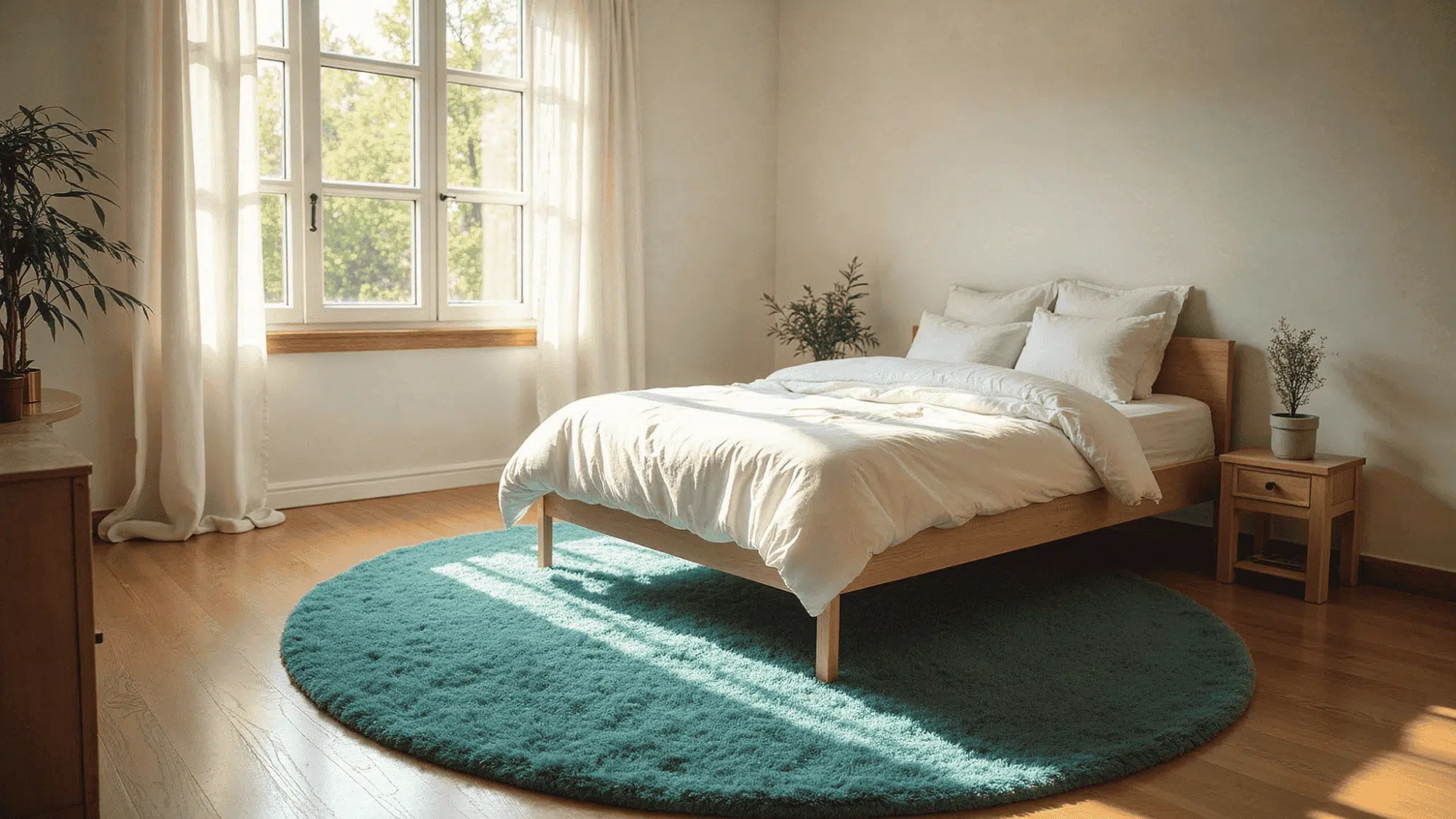
Oversizing here makes the bed look tiny, and the room feel awkward rather than cozy.
How Wide is a Twin-Size Bed?
A twin bed measures 38 inches wide and 75 inches long, making it the smallest standard bed size that needs careful rug proportioning.
| Twin Size Rug Type | Rug Dimensions | Placement Style | Coverage |
|---|---|---|---|
| Standard twin rug | 5′ x 8′ | Under the lower two-thirds | 8” sides, 12” feet |
| Compact twin rug | 4′ x 6′ | Under the lower half | 6” sides, 8” feet |
| Shared twin rug | 8′ x 10′ | Between two twin beds | Covers the gap and sides |
| Wall-flush setup | 4′ x 7′ | Against the wall edge | Open side coverage only |
| Kids’ room rug | 5′ x 7′ | Centered placement | Play space included |
| Dorm room size | 4′ x 6′ | Minimal footprint | Space-saving option |
Note: Twin beds can look lost on oversized rugs, so stick with smaller rugs that maintain proportion.
Rug Length
Twin beds work best with 7 to 8 feet of rug coverage. The 75-inch mattress needs a modest extension; longer rugs overpower the small bed frame, and shorter ones leave inadequate foot space.
Eight-foot rugs strike the perfect balance, offering enough surface without overwhelming children’s or guest rooms.
Rug Width
The width should stay between 4 and 5 feet for twin beds to avoid disproportionate coverage.
The narrow 38-inch frame is easily swallowed by wider rugs.
Four-foot widths give the tiniest but sufficient side exposure. Five-foot options work when the bed sits centered in the room, allowing balanced margins without creating the floating furniture effect.
Why it Works
- Keeps proportions appropriate for smaller furniture.
- Doesn’t dominate kids’ rooms or guest spaces.
- Makes the bed feel intentional, not lost.
Things to Keep in Mind
- Consider two twins in the guest rooms differently.
- Kids’ rooms need washable rug materials.
Is a Rug Pad Necessary for All Rugs?
Rug pads aren’t technically required, but they solve multiple problems at once. They prevent rugs from sliding when stepping on or off the bed.
They add cushioning that makes mornings more comfortable on bare feet.
They protect floors from rug backing that can scratch hardwood or trap moisture on tile.
They also extend rug life by reducing friction-induced wear. Without pads, rugs bunch up, shift position constantly, and wear out faster.
The small investment saves money and eliminates the daily frustration of straightening crooked rugs.
Choosing the Right Rug Shape for Your Bed
Choosing the right shape affects both the function and the style of a bedroom.
| Rug Shape | Best For | Why It Works |
|---|---|---|
| Rectangle | All bed types | Matches the bed’s natural shape and room layout |
| Square | Square rooms | Creates balance in non-standard room dimensions |
| Round | Small spaces | Softens corners and adds visual interest |
| Runner | Foot of the bed | Provides a landing spot without full coverage |
| Oval | Traditional rooms | Offers curved lines in formal settings |
Rug Alignment for a Neat Look
How a rug aligns with furniture determines whether a bedroom looks intentional or haphazard.
1. Parallel Alignment With the Bed Frame
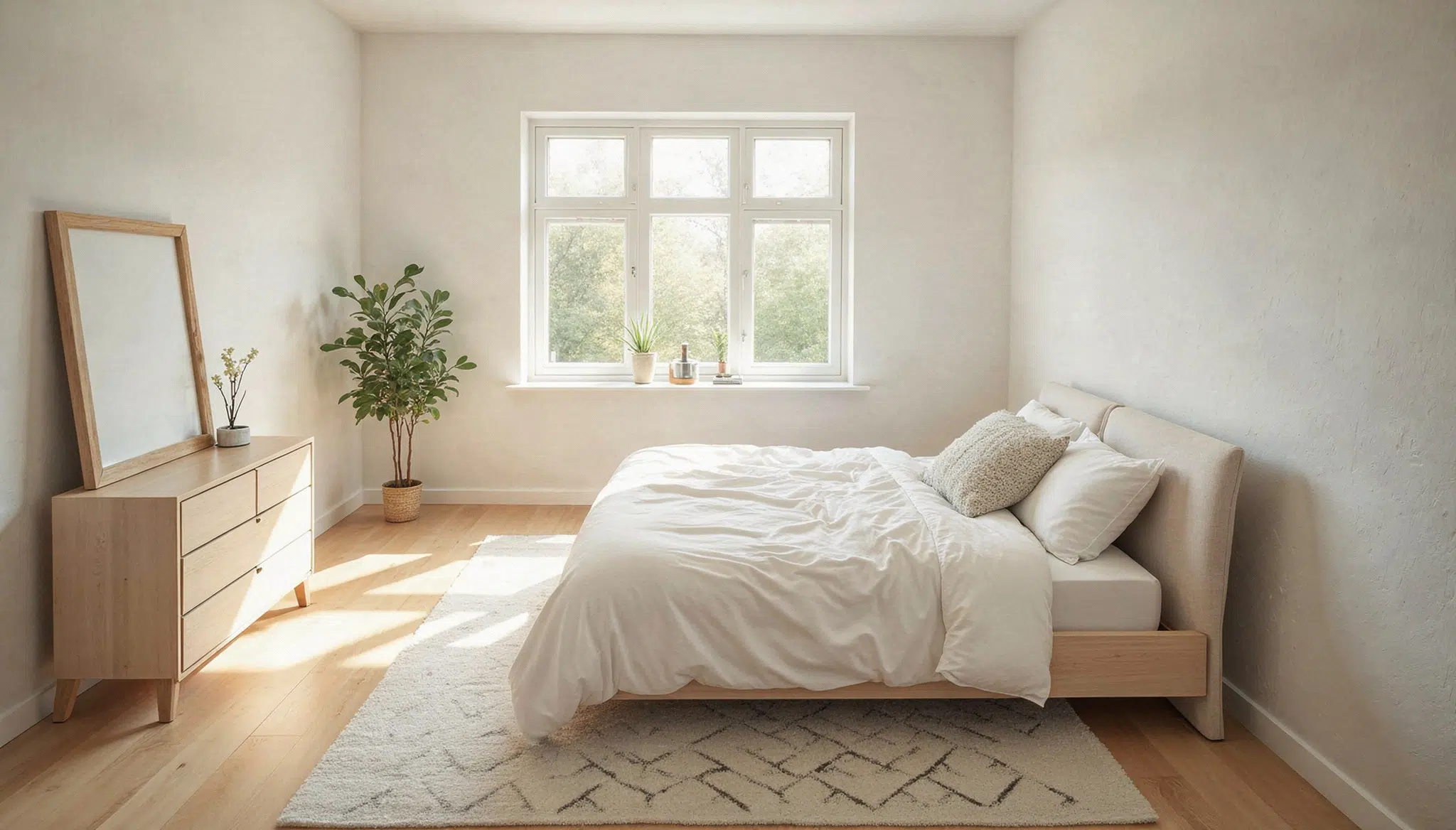
The rug’s edges should run parallel to the bed frame’s sides and foot.
When lines match up, the eye reads the space as organized. Angled or skewed placement creates visual tension that makes people feel uncomfortable without knowing why.
2. Alignment With Architectural Features

Rugs should align with door frames, windows, or built-in features when possible. If a window sits centered on one wall, center the rug beneath it too.
This connects the rug to the room’s permanent structure, rather than making it feel randomly dropped in.
3. Straight Edge Alignment With Floorboards
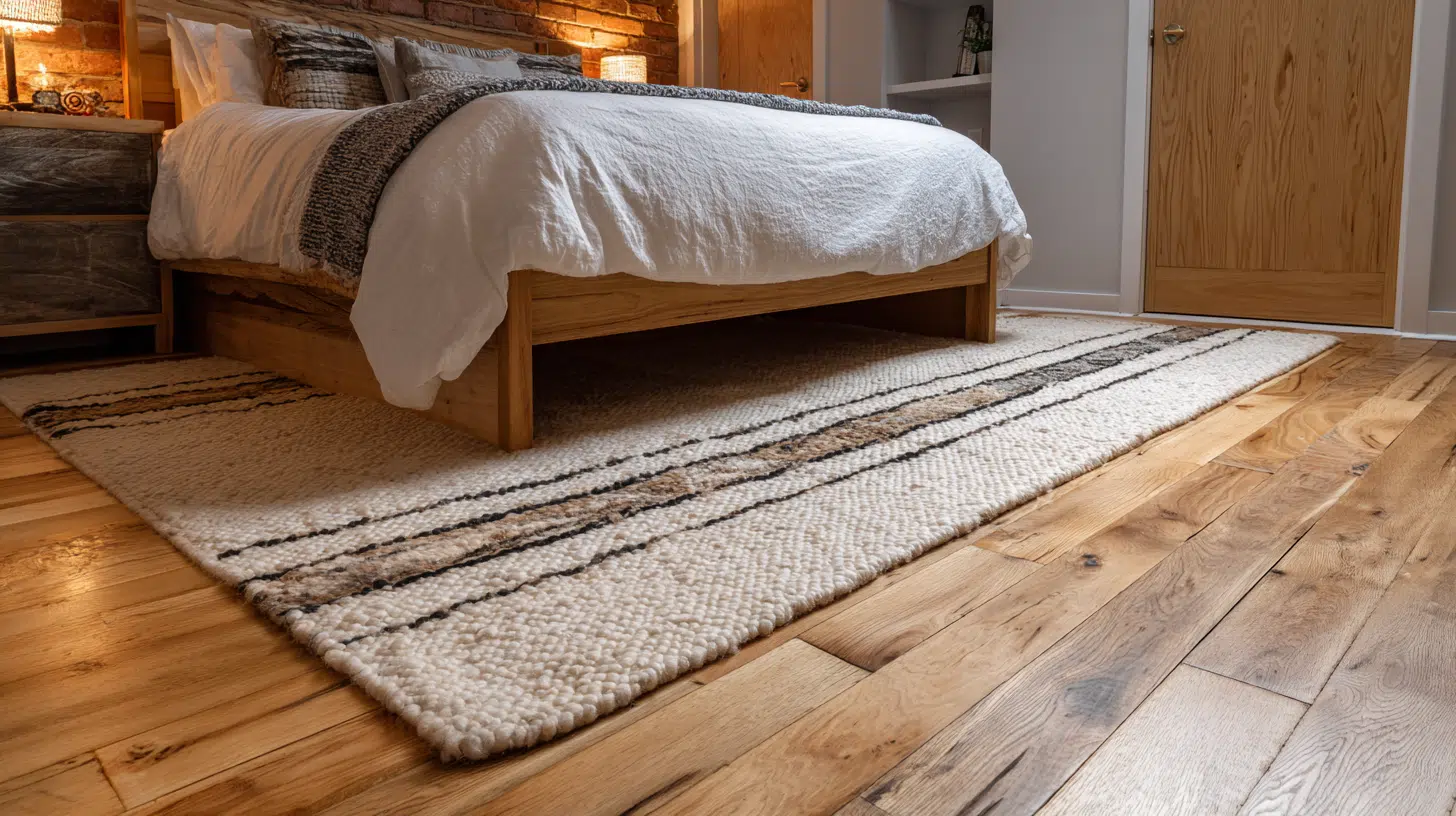
If the room has visible floorboards or tile lines, align the rug parallel to these. Fighting against existing floor patterns creates chaos.
Following them makes everything flow naturally, even with different materials or colors.
4. Headboard and Rug Edge Coordination
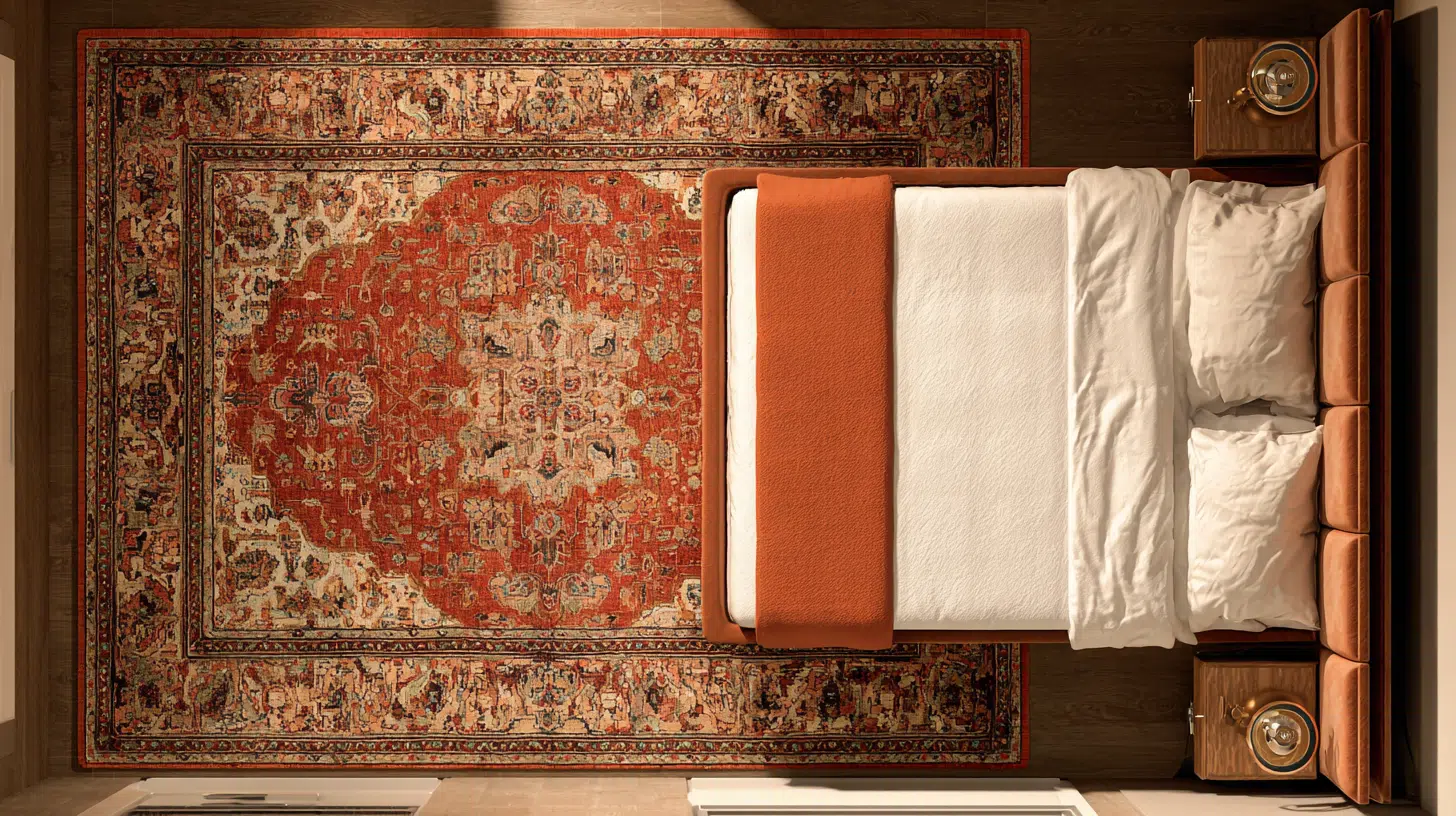
The rug’s top edge works best when it stops before reaching the headboard base.
Leave 6 to 12 inches of space between the rug’s end and the headboard’s start. This gap prevents the rug from disappearing completely while maintaining clear visual separation.
5. Alignment With Bedside Table Legs
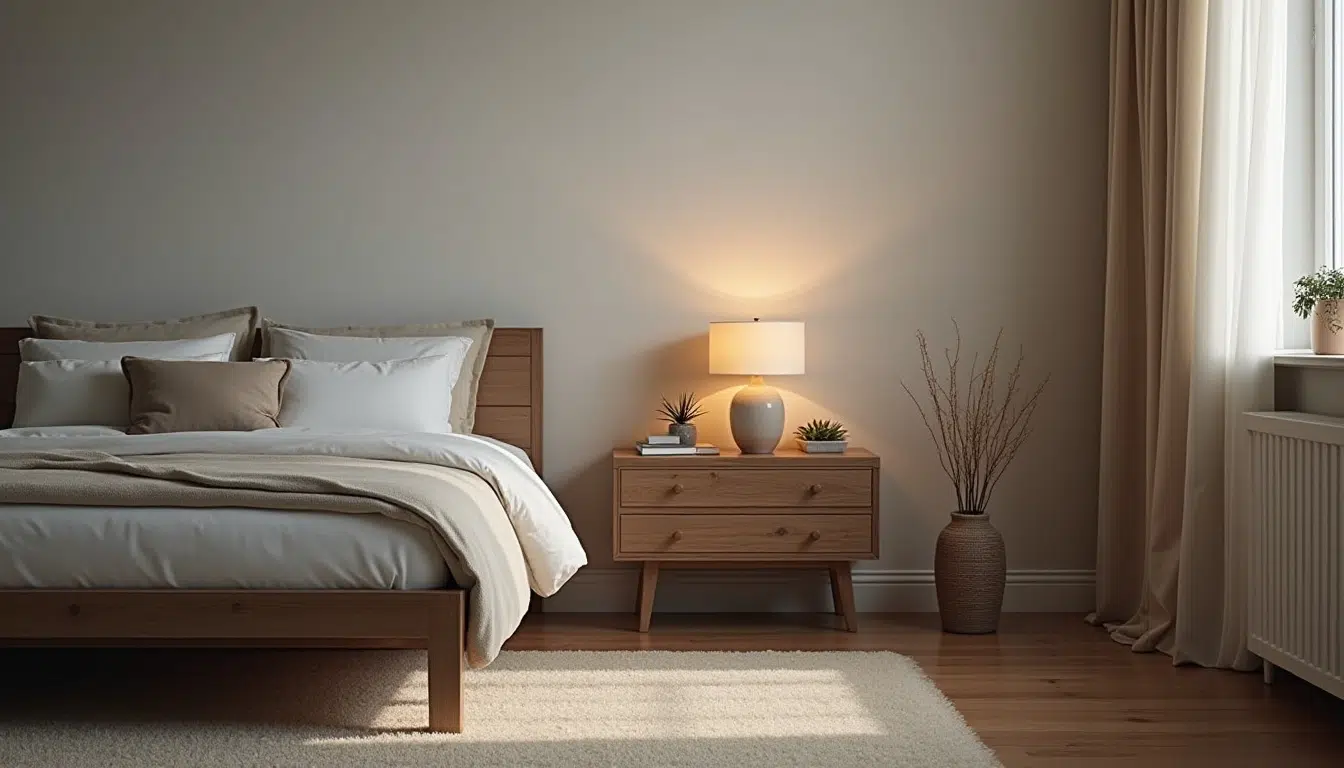
The front legs of bedside tables should rest on the rug, while the back legs can stay off.
This partial placement creates a connection without forcing tables completely onto the rug.
It looks purposeful and keeps tables stable, even on uneven surfaces or rug edges.
Picking the Best Rug Material for Under a Bed
| Rug Material | Best Feature | Watch Out For |
|---|---|---|
| Wool | Durable and hot | Needs professional cleaning occasionally |
| Cotton | Washable and affordable | Wears out faster than wool |
| Jute | Natural texture | Rough on bare feet |
| Synthetic | Stain-resistant | Can feel less luxurious |
| Sheepskin | Ultra soft | High maintenance required |
| Silk | Refined appearance | Expensive and delicate |
| Bamboo | Eco-friendly | Limited softness underfoot |
Final Thoughts
Getting a rug under bed rules changes how a bedroom looks and feels.
The rules covered here, from size proportions to alignment tricks, work for any bed type or room size. They’re not complicated, just specific. Start by measuring the space accurately. Use tape to visualize boundaries.
Choose a rug that extends on all sides. Center everything and ensure furniture is properly placed.
No more wondering if the rug looks right or second-guessing purchases.
Just follow the measurements, respect the proportions, and the bedroom will look professionally designed.
Now it’s time to find the perfect rug and position it correctly.
Frequently Asked Questions (FAQ’s)
1. What is the Rule for a Bedroom Rug?
Two-thirds under the bed, one-third exposed, with equal side coverage always.
2. What is the Rule of Area Rugs?
Leave 12 to 18 inches of bare floor showing between the rug and the walls.
3. What is the 18-Inch Rule for Rugs?
Rugs should extend at least 18 inches beyond the bed sides and the foot for balance.
4. What is the Rule of Layering Rugs?
Place a smaller rug centered on a larger one; contrasting textures and complementary colors work.