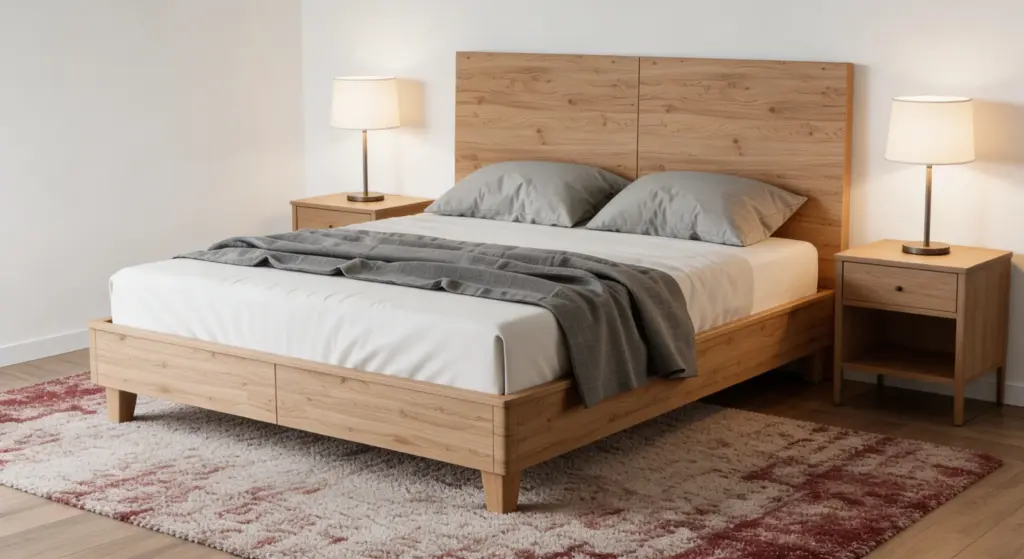
The most common bedroom rug placement mistake isn’t picking the wrong colour or pattern. It’s buying the wrong size and placing it too high up near the headboard.
A rug that barely peeks out from under the bed doesn’t ground the room.
It just looks like you ran out of floor.
Getting it right comes down to a few simple rules around size, placement, and how much rug shows on each side.
The Importance of Right Rug Placement
A rug does three things in a bedroom.
- It anchors your furniture so nothing looks like it’s floating.
- It adds heat underfoot right where you need it, beside the bed, not buried under it.
- It visually separates the sleeping area from the rest of the room.
Get the placement wrong, and the whole space looks off.
Not because your furniture is bad or your taste is wrong. Just because the rug isn’t doing its job.
Before anything else, measure your actual floor space, not just your bed size. Note the distance from the bed to the door, to the dresser, and to the walls on both sides. A rug that works on paper can feel cramped if it cuts off a natural walkway.
The 3 Standard Placement Methods
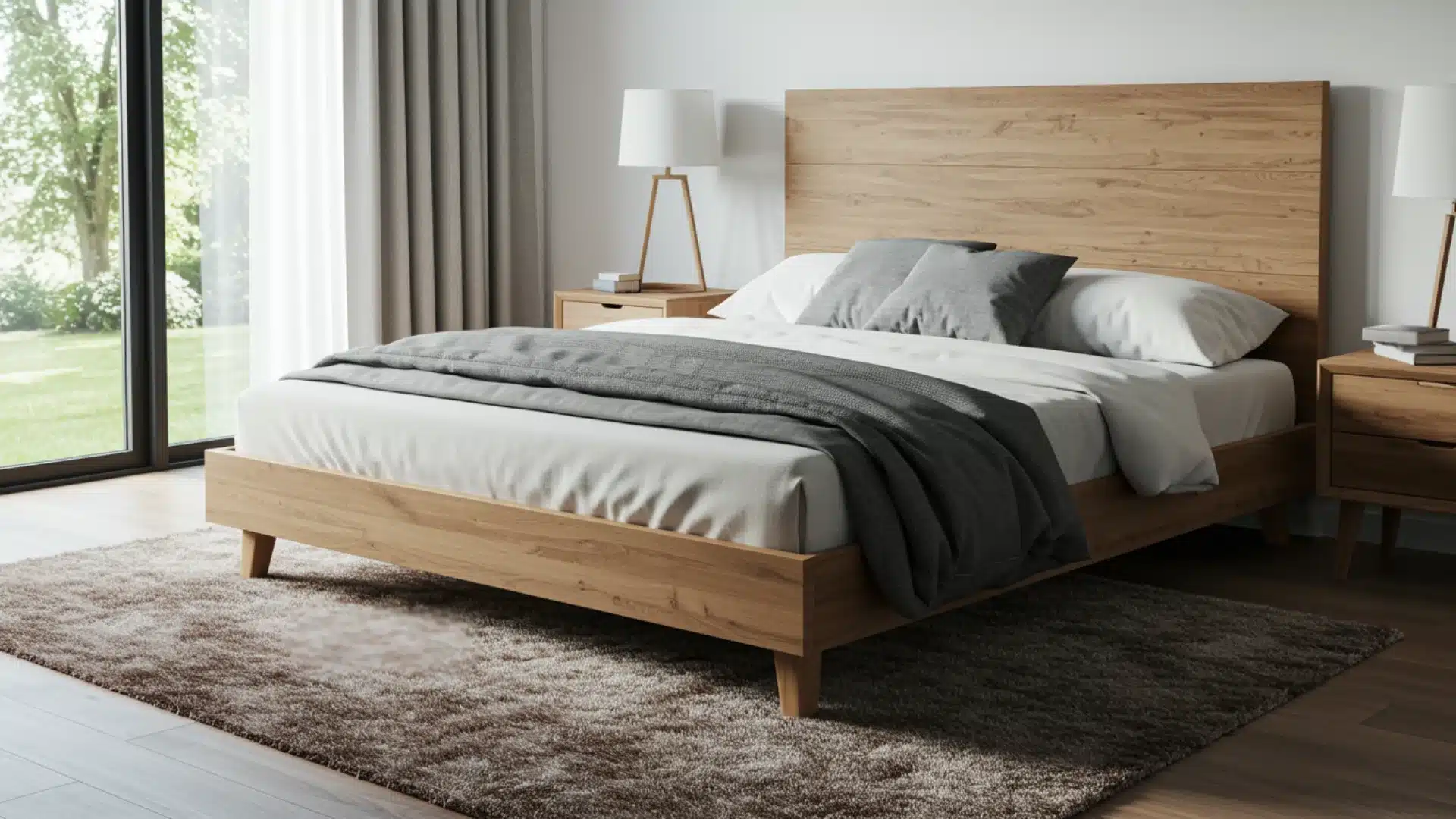
If you’re figuring out how to place a rug in a bedroom, there are three methods that work, each one suited to a different room size.
Method 1: Full Anchor
The rug sits under everything: the bed, the nightstands, and any bench at the foot of the bed. The entire sleeping area rests on top of it. It looks the most luxurious and put-together of the three methods.
It needs a large rug to pull it off. For a queen bed, you need a 9×12. For a king, go with a 10×14.
Use this in bedrooms where you want a cozy aesthetic ambience.
Method 2: Two-Thirds Under
The rug starts just below the nightstands and extends past the foot of the bed.
Both sides and the foot show rug, but the nightstands sit off to the side.
This is the most popular area rug placement bedroom and works well in most standard-sized rooms.
For a queen bed, an 8×10 does the job. For a king, go with a 9×12.
Method 3: Foot-of-Bed Runner
A smaller rug or runner is placed only at the foot of the bed, running perpendicular to it.
Your feet hit the heat as soon as you get out of bed, which is the main purpose of a bedroom rug. This works best in small bedrooms where a full-sized rug would dominate the space.
A 2.5×8 or 3×10 runner is ideal here.
Quick Rug Size Reference Table
Not sure what size rug for a bedroom works best with your bed?
This bedroom rug size guide makes it simple to match your bed size to your preferred placement method.
| Bed Size | Method 1 (Full Anchor) | Method 2 (Two-Thirds) | Method 3 (Runner) |
|---|---|---|---|
| Twin | 6×9 | 5×8 | 2×6 |
| Twin XL | 6×9 | 5×8 | 2×6 or 2.5×8 |
| Full / Double | 8×10 | 6×9 | 2.5×8 |
| Queen | 9×12 | 8×10 | 2.5×8 or 3×10 |
| King | 10×14 | 9×12 | 3×10 |
| California King | 10×14 | 9×12 | 3×10 |
| Split King | 10×14 | 9×12 | 3×10 |
If your bed sits against a wall on one side, symmetrical placement won’t work. In this case, shift the rug so it extends the full 18–24 inches on the open side and the foot, and let it tuck partially under the wall-side of the bed. The priority is always where your feet land, not perfect centering.
The Most Common Mistake
The biggest rug under bed placement error isn’t the rug itself; it’s where it ends up on the floor.
- Placing rugs too far toward the headboard is the most common mistake.
- The rug should extend at least 18–24 inches beyond the sides and foot of the bed.
- It shouldn’t just sit in the middle of the bed.
- If your feet hit bare floor when you get out of bed, the rug is in the wrong position or too small.
- The fix is usually to slide the rug further toward the foot of the room, not to buy a new one.
Should a Rug go Under Nightstands or Stop Before Them?
It depends on which placement method you’re using.
With the full anchor method, nightstands sit on the rug, which is the whole point. With the two-thirds method, the rug starts just below the nightstands, so they sit off it.
Both look intentional when done right.
The only thing that looks wrong is a rug that cuts awkwardly across the middle of a nightstand leg.
Fully on or fully off, pick one and commit to it.
Layering Two Rugs Together
Layering works better than most people expect.
Start with a large neutral base, such as jute or cotton, which works well, then place a smaller, more textured or patterned rug on top. You can centre it or angle it slightly.
Either way, the overlap should be at least 6 inches.
It’s the easiest way to add visual depth to a bedroom without replacing what you already own.
It also solves the problem of a rug that’s slightly too small to work on its own.
Wrap Up!
Bedroom rug placement comes to three things: the right size, the right method, and the right position on the floor.
A rug that extends 18–24 inches past the sides and foot of the bed will always look more grounded than one pushed too far toward the headboard. Start with the two-thirds method if you’re unsure.
It works in most standard bedrooms and most standard bed sizes.
Got a rug that’s slightly too small? Layer it. Wrong position? Slide it toward the foot.
Most fixes are simpler than buying something new.
Frequently Asked Questions (FAQ’s)
1. What is the Rule of Thumb for Bedroom Rugs?
The rug should extend at least 18–24 inches beyond each side of the bed.
2. Does a Rug Make a Bedroom Look Bigger or Smaller?
The right size rug makes a bedroom look bigger and more grounded.
3. How to Make Your Bed Look Luxurious?
A large, well-placed rug anchors the bed and makes it look expensive.
4. Are People Still Carpeting Their Bedrooms?
Yes, but area rugs offer more flexibility, style, and easier replacement than full carpet.
5. What is the 60 30 10 Rule for Bedroom Design?
60% dominant colour, 30% secondary colour, and 10% accent colour throughout the room.