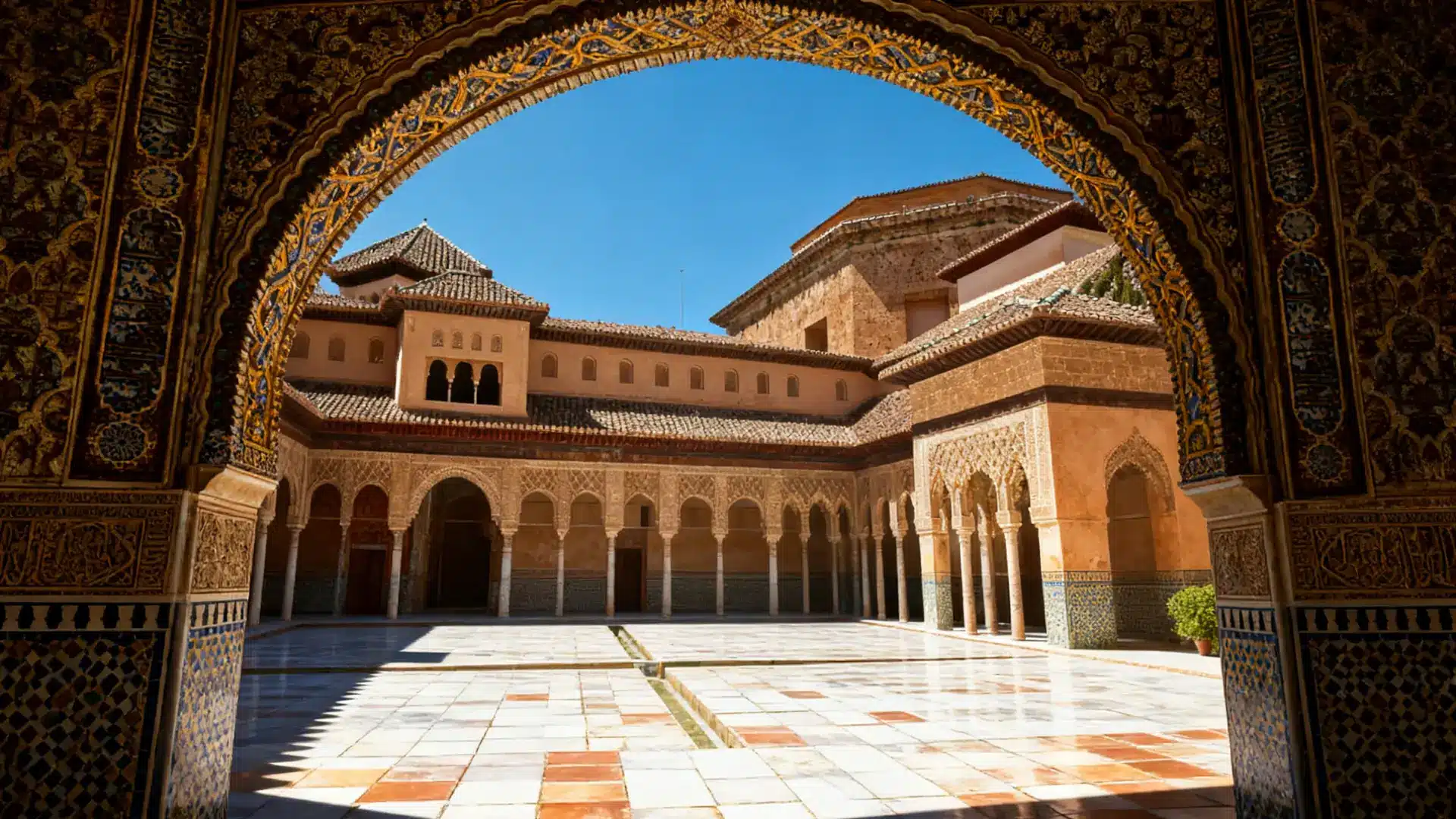
Three civilizations. One region. Centuries of building on top of each other.
What came out of southern Spain’s architecture, between 711 and 1492, was not a compromise.
Andalusian Architecture: History, Features, Examples is the story of three civilizations, one region, and a building tradition none of them could have created alone.
Horseshoe arches, courtyards that outsmart the heat, and tilework built on pure mathematics.
No single culture could have produced this alone.
What is Andalusian Architecture?
Walk through any old city in southern Spain and something will catch you off guard.
A doorway shaped like a horseshoe. Walls covered in hand-cut tiles.
Architecture in Spain never developed from a single source. It was always the result of multiple cultures building on the same ground.
It grew out of Al-Andalus, the Muslim-ruled Iberian Peninsula between 711 and 1492, where Islamic, Roman, and Mediterranean building traditions collided and merged.
Every pattern, arch, and open courtyard had a reason. That same thinking still shows up in modern homes and public spaces today.
The History of Andalusian Architecture
| Era | Key Shift |
|---|---|
| 711 AD | Islamic rule introduced geometric patterns and courtyard design |
| 756 to 1031 | Umayyad dynasty built grand mosques and palace cities |
| 1230 to 1492 | Nasrid rulers refined tilework and built the Alhambra |
| Post 1492 | Mudejar style blended Islamic and Christian design traditions |
| 19th century onward | Neo-Moorish revival spread across Europe and America |
No single culture built this style alone. It grew through centuries of conquest, coexistence, and change.
Romans laid the groundwork. Muslim rulers transformed it into something extraordinary.
Christian kings kept what worked and added their own layer on top.
Each era left a mark that the next one built upon rather than erased. That back and forth is exactly what gives Andalusian architecture its depth.
Key Features of Andalusian Architecture
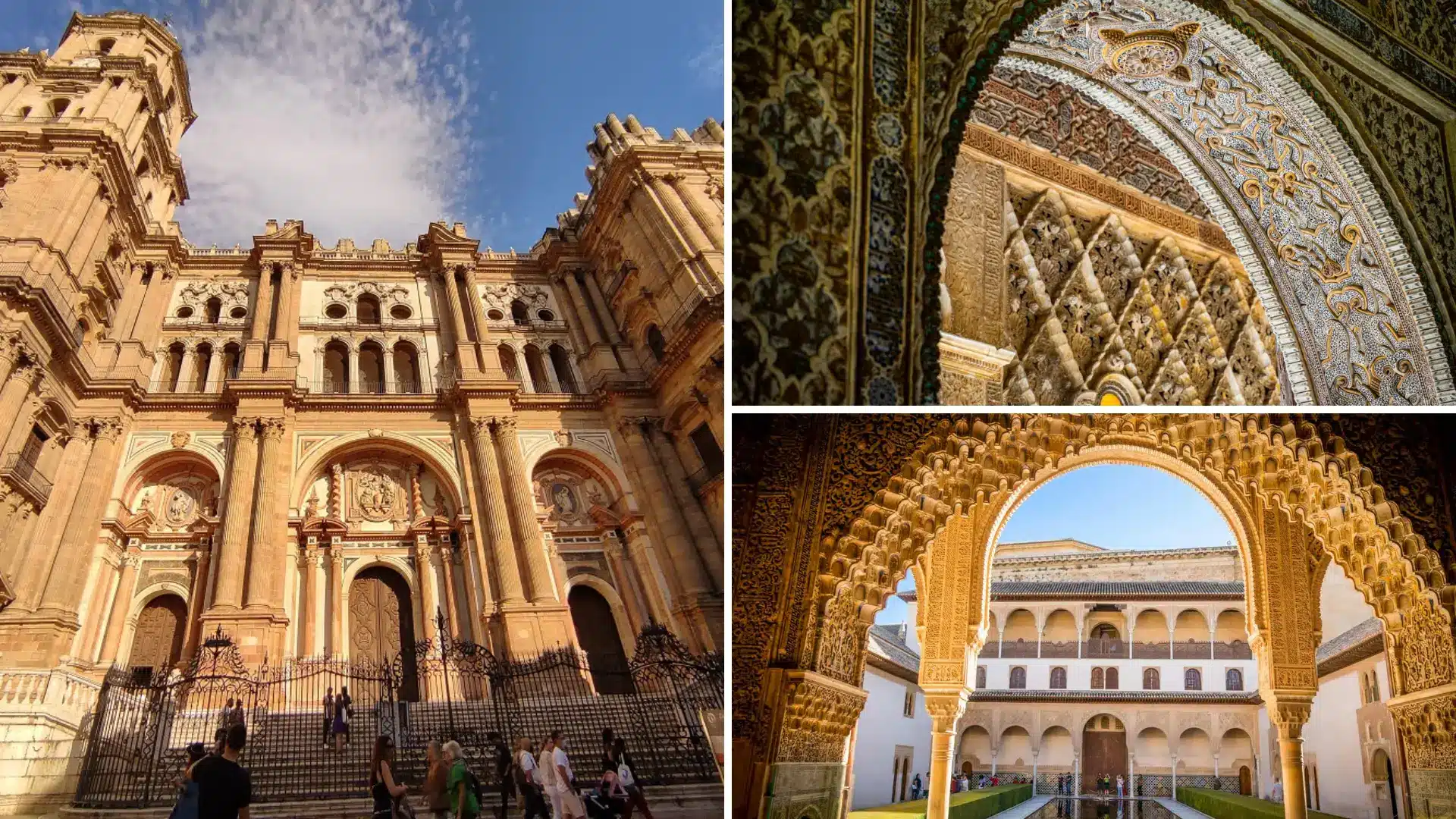
These features did not appear by accident.
Each one solved a problem, carried a meaning, or served a purpose beyond appearances.
1. Horseshoe Arches and Decorative Columns
The horseshoe arch curves inward at the base, allowing taller interior spaces without thicker support walls. Columns were arranged in repeating rows, giving large halls rhythm and depth.
Many were repurposed directly from older Roman structures.
2. Intricate Tilework and Geometric Patterns
Hand-cut tiles called azulejos were arranged into mathematically precise patterns featuring stars, hexagons, and interlocking polygons.
Since Islamic tradition avoided depicting living figures, geometry became the primary visual language.
The more complex the pattern, the more care it represented.
Decor tip: One geometric tiled wall creates far more impact than covering every surface.
3. Courtyards and Water Elements
Central courtyards allowed cool air to circulate naturally through buildings during intense southern Spanish summers.
Fountains and shallow pools dropped surrounding temperatures through evaporation.
Reflective pools also made spaces feel larger and more open than they actually were.
4. Carved Plaster and Wood Details
Artisans cut patterns into wet plaster by hand, covering walls with arabesques, calligraphy, and geometric borders.
Wooden ceilings called artesonado used interlocking geometric panels fitted without nails.
Many of these surfaces have survived completely intact for centuries.
5. Use of Light and Open Spaces
Builders positioned windows, arches, and open corridors to control how sunlight moved through a space across the day.
Carved screens and latticed panels cast shifting patterns on floors and walls. Light was treated as a design material, as deliberate as tile or stone.
What is Spanish Revival Architecture called?
Moorish architecture was not just a building style.
It was a design philosophy that reshaped how southern Spain looked, felt, and functioned.
It arrived in 711, bringing Islamic building traditions that Europe had never seen before.
It drew from multiple cultures, Islamic, Roman, Byzantine, and North African, making it unlike anything before it.
Horseshoe arches became its signature, one of the most copied shapes in architectural history.
Surface decoration was its strength, tilework, carved plaster, and wooden ceilings built on mathematical precision.
Courtyards and water features kept buildings cool, connecting indoor and outdoor spaces naturally.
Its influence never disappeared. After 1492, Andalusian Architecture: History, Features, Examples continued to shape the Mudejar style and inspire designers worldwide.
Famous Buildings in Spain
These four buildings show exactly what Andalusian architecture produced across its history.
1. Alhambra Palace, Granada
Built by the Nasrid dynasty in the 13th and 14th centuries, the Alhambra sits above Granada as a palace, fortress, and garden complex combined.
What stops most visitors is not its scale but its detail.
- 124 marble columns surrounding a central fountain in the Court of the Lions
- Muqarnas ceilings that shift visually with natural light
- Generalife gardens, where water and landscape are treated as part of the architecture
Decor tip: Intricate pattern on a single wall outperforms decoration spread across every surface.
2. Great Mosque of Córdoba
Built in 784 and expanded multiple times, its interior is defined by double-tiered horseshoe arches in alternating red and white stone.
After the Reconquest in 1236, a cathedral was built directly inside the mosque.
The two sit side by side today, neither fully erasing the other.
3. Alcázar of Seville
Originally built in the 10th century under Umayyad rule, it was later expanded by Christian kings using Muslim artisans.
Geometric tilework, coffered wooden ceilings, and Islamic water features are set within a Gothic framework.
It belongs to neither tradition fully, yet feels coherent throughout.
Pro tip: The Alcázar is still an active royal residence, making it one of the oldest functioning palaces in the world.
4. Medina Azahara
Built by Abd al-Rahman III outside Córdoba as an entire palace city.
Largely destroyed within a century and buried for nearly a thousand years.
What exists today shows the scale and ambition of early Andalusian urban design better than any standing building can.
Conclusion
Andalusian architecture is not a relic of the past.
It is a living record of what happens when multiple cultures build on the same soil long enough to create something none of them could have produced alone.
The arches, tilework, courtyards, and carved walls that define it were never just decorative.
They were solutions, expressions, and statements all at once.
Frequently Asked Questions
1. What Materials Were Commonly Used in Andalusian Architecture?
Brick, limestone, marble, ceramic tile, carved plaster, and wood were the primary building materials.
2. How Did Andalusian Architecture Influence Latin America?
Spanish colonizers brought courtyard layouts, tiled surfaces, and arched walkways into colonial-era buildings across Latin America.
3. What Is the Difference Between Moorish and Mudejar Architecture?
Muslim artisans for Muslim rulers built Moorish structures, while Mudejar artisans blended Islamic decoration with Christian structural frameworks after the Reconquest.
4. Are Any Andalusian Buildings Still Used Today?
Yes, the Alcázar of Seville remains an active royal residence, and several others function as museums and cultural centers.
5. Why Did Andalusian Architects Prioritize Interiors Over Exteriors?
Islamic design philosophy valued inward richness over outward display, keeping exteriors plain and interiors extraordinarily detailed.